Sunday, July 30, 2006


Dembowski Endorsed by Retirees

News Release
The Executive Board of the Steelworkers Organization of Active Retirees (SOAR) Chapter 30-18, had no difficulty recently in unanimously endorsing Nancy Dembowski, candidate for Indiana House District 17. This chapter of SOAR is composed of former employees of NIPSCO.
Mrs. Dembowski, the former Mayor of Knox, Indiana, and former State Senator, assured the organization that she would be responsive to the local needs of working families and retirees before downstate politics. Also, she said that doing the right thing by our children and grandchildren is more important to her than short-term political gain and quick cash.
She also said she would fight to relieve the burden of rising property taxes, and ensure that the Legislature actually consider the impact of how every law they debate effects working families and retirees.
The chapter was impressed with the fact that Nancy Dembowski’s late husband, Ed, was a former Steelworker and an active member of SOAR. Nancy has been an active member of SOAR for several years.
The chapter was pleased by the fact that Nancy found the time to speak to the retirees on their first request. Chapter President, Charlie Averill noted, “We’ve been trying to get our current State Representative to come to one of our meetings for two years now, but he’s just been unresponsive.”
Charlie went on to say, “Both our state representative, Steve Heim, and our U. S. Congressman, Chris Chocola, do not vote with the best interest of Indiana citizens at the forefront.”
“Even though the majority of people opposed the leasing of the Indiana Toll Road, Representative Heim voted against the wishes of his constituents, and voted the way Governor Daniels wanted him to vote. On the national level, Congressman Chocola has a miserable voting record with regards to issues which would help the average Indiana citizen, particularly on those issues affecting working families and retirees.”
“It is pretty sad and downright maddening how our government is not “of and for the people” anymore. We need to make a change and I think that supporting Nancy is the first step in regaining a fair and equal playing field for all Indiana citizens.”
Source: Elaine Averill, SOAR Chapter 30-18 Recording Secretary
Wednesday, July 26, 2006
Tentative Agreement At BFGoodrich
July 25, 2006
(Knoxville, Tenn.) -- The United Steelworkers (USW) announced this evening that a tentative agreement has been reached at BFGoodrich. The master agreement covers 4,000 members at three plants in Fort Wayne, In., Tuscaloosa, Ala. and Opelika Ala. BFGoodrich was designated last month as the target company in establishing an agreement in the tire industry. Master contracts are also being negotiated at Goodyear and Bridgestone/Firestone.
Details of the tentative agreement will not be released until membership at the three locals conduct informational meeting on the proposed contract. Ratification votes will then take place at the three locations. A "majority of the majority" will be required for contract ratification. This means that 50% plus one vote overall and two-of-the three locals must vote to accept the tentative agreement for it to become contract.
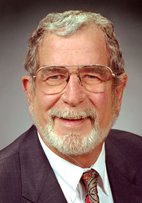 "We believe we achieved our industry goals when it comes to protecting retiree health care benefits and securing additional job protection measures for our active members," said USW executive vice president Ron Hoover.
Typically, informational meetings and ratification votes take place within two weeks of announced tentative agreement.
The USW represents some 70,000 members in the tire, rubber and plastics industry, and 850,000 overall in the U.S. and Canada.
Source: Steelworkers website
Friday, July 21, 2006
Bush's NLRB
Report Points to Unfair and Inconsistent Rulings in Favor of Employers
The Democratic staff led by Rep. George Miller (D-Calif.), ranking Democrat on the House Committee on Education and the Workforce, have produced a 25-page report detailing how the rulings of the National Labor Relations Board (NLRB) have either taken away or "severely restricted" the rights of millions of workers to organize into unions over the past five years.
"President Bush has filled the NLRB with anti-union members who have made it more difficult for workers to organize a labor union," Miller said in a statement releasing the report, Workers' Rights Under Attack by Bush Administration: President Bush's National Labor Relations Board Rolls Back Labor Protections. The NLRB has "used double standards, rationales, and unfair, inconsistent rulings to give employers more power over workers," he said.
The report lists several large groups of workers who have been excluded from the protection of the National Labor Relations Act (NLRA) by ruling that they are not employees.
Examples of hypocrisy and unfairness are highlighted as the NLRB applies double standards to supervisors' anti-union and pro-union conduct. In one such case, when a supervisor campaigned against a union, the NLRB deemed it free speech. When a supervisor campaigned for a union, however, the Bush Board overturned the entire union election.
The Bush Administration continues to undermine an already weak federal labor law, as Democrats fight to "strengthen workers' protections" through the Employee Free Choice Act (H.R. 1696, S. 842). The legislation, which would require employers to recognize a union through a "card-check" process that does not include a formal election, has 216 bipartisan co-sponsors in the House and 43 in the Senate, but the Republican leadership has refused to give the bill a hearing or a vote.
The summary concludes that "millions of workers have lost their right to organize into unions, their basic rights have been trampled, and businesses have essentially been given free rein to make it as difficult as possible for their employees to organize."
Source: USW website
Thursday, July 20, 2006
Oman Free Trade Agreement
Our National Security is at Risk!
This week, lawmakers in the House of Representatives discovered alarming provisionsin the text of the Oman Free Trade Agreement (FTA) that could have major
implications for our national security interests.
• Under the agreement, companies such as Dubai Ports World – the same
operation that set off a political firestorm earlier this year when they tried to
purchase the right to operate our ports – could set up in Oman and then attempt
to acquire a U.S. port operation.
• Even if Congress opposes this, the Oman FTA would allow the company to drag
the U.S. in front of UN or World Bank tribunals to demand our country
compensate them for any lost profits!
• This could happen with our ports or other national security assets.
Is this really the time for Congress to consider an agreement that not only puts workers
at risk, but also our national security? How much more can we bow down to corporate
interests?!?
Supporters of the Oman FTA are working overtime to play down this news. Don’t let
that happen! The vote in the House is scheduled for TODAY.
Please make sure to call your Representative and pressure him or her to vote against the Oman Free Trade Agreement. As a reminder, the toll-free number for the Capitol Switchboard is 866-340-9279.
Source: USW Rapid Response
Tuesday, July 18, 2006
Peabody Miners: Fed Up and Fired Up
Mine Workers (UMWA) President Cecil Roberts often says: “When you get fed up and fired up, you got to get ready to stand up.” Coal miners are standing up in the coalfields across the country, demanding to be treated with respect and to have a voice to make sure their jobs are well paid and safe.
In recent years, the UMWA has responded to the requests of hundreds of nonunion miners at Peabody Energy’s facilities across the country for assistance in getting a voice at work. In December 2005, workers at 19 Peabody mines in Illinois, Indiana, Kentucky, Ohio, Tennessee and West Virginia launched the Justice at Peabody campaign.
Says John Cox, a miner at Peabody’s Farmersburg (Ind.) mine:
I pay anywhere between $300 to $500 a month in prescription drug costs because of Peabody’s sub-par health benefit package. Only with a union contract will we have better pay and benefits because it’s obvious Peabody is not going to give it to us.
Peabody, the world’s largest private coal company, provides 10 percent of the nation’s electricity and 3 percent of the world’s power and employs some 8,300 miners at 33 mines in nine states. Peabody systematically closed its union mines and replaced production with nonunion mines over the past 15 years, says Bob Gaydos, UMWA’s_assistant organizing director.
Another Peabody miner, Greg Arnold of Indiana, took part in a December rally at Peabody headquarters in St. Louis, where he said his mine shift involves “eleven-hour shifts Monday through Friday, then another eight hours on Saturday—without a lunch break.” Despite this grueling 63-hours-a-week schedule, he receives no sick days. “I’d like a voice about my job—a seat at the table,” Arnold said.
A union contract also goes a long way toward improving safety conditions—with the danger of mines illustrated this year by the deaths of 33 miners, five in Harlan County, Ky., and 12 who were killed Jan. 2 in the Sago Mine explosion in West Virginia. More miners have died on the job this year than in any full year since 2001, when 42 were killed. More than 90 percent of the miners killed this year worked in nonunion mines.
Late last month, more than 1,500 miners and their supporters rallied in Wharton, W.Va., to call for the freedom of Peabody mine workers to join a union.
Roberts says the Peabody miners work in a climate of fear:
Workers have a basic human right to form a union where they work. And they have a right to do that without being subjected to intimidation from the company, without being fearful of losing their jobs, without having to go through a campaign of half-truths and outright lies from the company’s union-busting consultants.
The climate of fear that permeates non-union mines throughout America’s coalfields must end, and end now. Non-union miners are afraid that if they speak up about safety, they’ll get fired. They’re afraid that if they speak up about getting decent pensions and better health care for their families, they’ll get fired.
Cox recently took the fight for a union at Peabody to Dugger, Ind., where the town council was considering a resolution supporting the miners’ quest for a voice at work.
We work long hours and most weekends. When we retire, we have no pension and no health insurance.
After Cox spoke, the council unanimously adopted the resolution supporting the rights of the area’s Peabody miners to organize a union free from employer interference. The resolution, passed July 6, calls on Peabody to allow its employees to choose freely whether to join a union. The resolution requests Peabody remain neutral and not resort to the use of pressure tactics, such as threats to close the mine, if the workers choose a union.
Says June Rostan, lead community organizer for the Peabody campaign:
I think the miners should have the right to decide whether they want to be union. Peabody workers like Cox are using their community ties and political strength to garner strong support from residents and leaders in towns where the mines are located. The Peabody miners are asking elected leaders in every town in which they work and live to pass a resolution similar to the one in Dugger.
The people in these towns support unions because they know the effect a union can have on their communities. Lots of folks in these towns receive Mine Workers health care benefits when they retire [from union mines] and they know firsthand how a union can be good for the town.
Other local councils that have passed resolutions include Kentucky’s Union County Fiscal Court (the equivalent of the county council) and city councils in Morton’s Gap, Ky., Boonville, Ind., Danville Township, Ill., and Nortonville, Ky.
The AFL-CIO and the local religious community is backing the miners’ struggle, and last month, the United Methodist West Virginia Area Conference adopted a resolution urging Peabody “to be truly neutral with respect to employees’ rights to form or join a union and to voluntarily recognize a union when a majority of their employees sign authorizations.”
To level the playing field for workers trying to form unions, AFL-CIO unions, including the UMWA, are supporting the Employee Free Choice Act. The legislation, which has 259 co-sponsors in the House and Senate, would strengthen workers’ freedom to choose union representation through a majority sign-up process. It also would provide for binding arbitration of first-contract disputes and authorize stronger penalties for violations of labor law when workers seek to form a union.
by James Parks
Source: AFL-CIO Blog
In recent years, the UMWA has responded to the requests of hundreds of nonunion miners at Peabody Energy’s facilities across the country for assistance in getting a voice at work. In December 2005, workers at 19 Peabody mines in Illinois, Indiana, Kentucky, Ohio, Tennessee and West Virginia launched the Justice at Peabody campaign.
Says John Cox, a miner at Peabody’s Farmersburg (Ind.) mine:
I pay anywhere between $300 to $500 a month in prescription drug costs because of Peabody’s sub-par health benefit package. Only with a union contract will we have better pay and benefits because it’s obvious Peabody is not going to give it to us.
Peabody, the world’s largest private coal company, provides 10 percent of the nation’s electricity and 3 percent of the world’s power and employs some 8,300 miners at 33 mines in nine states. Peabody systematically closed its union mines and replaced production with nonunion mines over the past 15 years, says Bob Gaydos, UMWA’s_assistant organizing director.
Another Peabody miner, Greg Arnold of Indiana, took part in a December rally at Peabody headquarters in St. Louis, where he said his mine shift involves “eleven-hour shifts Monday through Friday, then another eight hours on Saturday—without a lunch break.” Despite this grueling 63-hours-a-week schedule, he receives no sick days. “I’d like a voice about my job—a seat at the table,” Arnold said.
A union contract also goes a long way toward improving safety conditions—with the danger of mines illustrated this year by the deaths of 33 miners, five in Harlan County, Ky., and 12 who were killed Jan. 2 in the Sago Mine explosion in West Virginia. More miners have died on the job this year than in any full year since 2001, when 42 were killed. More than 90 percent of the miners killed this year worked in nonunion mines.
Late last month, more than 1,500 miners and their supporters rallied in Wharton, W.Va., to call for the freedom of Peabody mine workers to join a union.
Roberts says the Peabody miners work in a climate of fear:
Workers have a basic human right to form a union where they work. And they have a right to do that without being subjected to intimidation from the company, without being fearful of losing their jobs, without having to go through a campaign of half-truths and outright lies from the company’s union-busting consultants.
The climate of fear that permeates non-union mines throughout America’s coalfields must end, and end now. Non-union miners are afraid that if they speak up about safety, they’ll get fired. They’re afraid that if they speak up about getting decent pensions and better health care for their families, they’ll get fired.
Cox recently took the fight for a union at Peabody to Dugger, Ind., where the town council was considering a resolution supporting the miners’ quest for a voice at work.
We work long hours and most weekends. When we retire, we have no pension and no health insurance.
After Cox spoke, the council unanimously adopted the resolution supporting the rights of the area’s Peabody miners to organize a union free from employer interference. The resolution, passed July 6, calls on Peabody to allow its employees to choose freely whether to join a union. The resolution requests Peabody remain neutral and not resort to the use of pressure tactics, such as threats to close the mine, if the workers choose a union.
Says June Rostan, lead community organizer for the Peabody campaign:
I think the miners should have the right to decide whether they want to be union. Peabody workers like Cox are using their community ties and political strength to garner strong support from residents and leaders in towns where the mines are located. The Peabody miners are asking elected leaders in every town in which they work and live to pass a resolution similar to the one in Dugger.
The people in these towns support unions because they know the effect a union can have on their communities. Lots of folks in these towns receive Mine Workers health care benefits when they retire [from union mines] and they know firsthand how a union can be good for the town.
Other local councils that have passed resolutions include Kentucky’s Union County Fiscal Court (the equivalent of the county council) and city councils in Morton’s Gap, Ky., Boonville, Ind., Danville Township, Ill., and Nortonville, Ky.
The AFL-CIO and the local religious community is backing the miners’ struggle, and last month, the United Methodist West Virginia Area Conference adopted a resolution urging Peabody “to be truly neutral with respect to employees’ rights to form or join a union and to voluntarily recognize a union when a majority of their employees sign authorizations.”
To level the playing field for workers trying to form unions, AFL-CIO unions, including the UMWA, are supporting the Employee Free Choice Act. The legislation, which has 259 co-sponsors in the House and Senate, would strengthen workers’ freedom to choose union representation through a majority sign-up process. It also would provide for binding arbitration of first-contract disputes and authorize stronger penalties for violations of labor law when workers seek to form a union.
by James Parks
Source: AFL-CIO Blog
Friday, July 14, 2006
Social Security Under Attack
The Bush Administration released its mid-session budget review on Tuesday, and it included a proposal to spend $721 billion over the next ten years to privatize Social Security - $9 billion more than originally proposed. In a speech on the budget, President Bush specifically alluded to the cuts to Social Security benefits which would be required as part of his plan, saying, "We need to cut entitlement spending." Americans United, a coalition that includes the Alliance and was crucial to beating back privatization efforts last year, is mounting a renewed campaign to call attention to individual politicians' positions on the issue. The group is drafting scripts for a national media campaign against candidates and incumbents, including Sen. Rick Santorum (R-PA) and Rep. Clay Shaw (R-FL). Americans United plans to begin the advertising blitz no later than the first week in August, kicking off in as many as five of its nearly 20 targeted states.
Previously, on a June 20 party-line vote, the Senate Budget Committee approved in a bill, S. 3521, a separate assault on Social Security that uses the line-item veto to make major changes in Federal budget laws. While described as a measure to restore fiscal discipline, the legislation actually represents a sneak attack on Social Security and Medicare. If enacted, S. 3521 would establish two commissions, either of which could be used to privatize Social Security and make deep cuts in Social Security and Medicare benefits. The “entitlements commission” would study Social Security, Medicare and Medicaid, and propose changes to these programs. The “sunset commission” is designed to evaluate Federal programs and then eliminate or modify them as the commission sees fit. The recommendations of both commissions would be considered under fast track procedures, allowing little public notice or debate, and few, if any, opportunities for senators to offer amendments. “The line item veto is often described as a tool to eliminate wasteful, ‘pork barrel spending,’ but this line item veto goes much further,” said Edward Coyle, Executive Director of the Alliance. “This could be used to eliminate improvements to Medicare and Social Security.”
Source: Alliance for Retired Americans Friday Alert July 14, 2006
Previously, on a June 20 party-line vote, the Senate Budget Committee approved in a bill, S. 3521, a separate assault on Social Security that uses the line-item veto to make major changes in Federal budget laws. While described as a measure to restore fiscal discipline, the legislation actually represents a sneak attack on Social Security and Medicare. If enacted, S. 3521 would establish two commissions, either of which could be used to privatize Social Security and make deep cuts in Social Security and Medicare benefits. The “entitlements commission” would study Social Security, Medicare and Medicaid, and propose changes to these programs. The “sunset commission” is designed to evaluate Federal programs and then eliminate or modify them as the commission sees fit. The recommendations of both commissions would be considered under fast track procedures, allowing little public notice or debate, and few, if any, opportunities for senators to offer amendments. “The line item veto is often described as a tool to eliminate wasteful, ‘pork barrel spending,’ but this line item veto goes much further,” said Edward Coyle, Executive Director of the Alliance. “This could be used to eliminate improvements to Medicare and Social Security.”
Source: Alliance for Retired Americans Friday Alert July 14, 2006
Tuesday, July 11, 2006
Monday, July 03, 2006
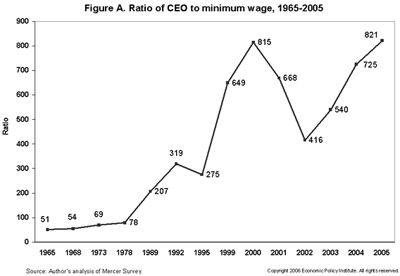
CEO-Minimum Wage Ratio Soars
In 2005, an average Chief Executive Officer (CEO) was paid 821 times as much as a minimum wage earner, who earns just $5.15 per hour. An average CEO earns more before lunchtime on the very first day of work in the year than a minimum wage worker earns all year.

This extreme compensation ratio reflects both the extraordinary growth of CEO pay and also the diminishing value of the federal minimum wage that has not been raised since 1997: adjusting for inflation, the purchasing power of the minimum wage is now at its lowest since 1955.
The ratio wasn't always so extreme. As recently as 1978, CEOs were paid only 78 times as much as minimum wage earners.
Written by Economic Policy Institute (EPI) president Lawrence Mishel.
This extreme compensation ratio reflects both the extraordinary growth of CEO pay and also the diminishing value of the federal minimum wage that has not been raised since 1997: adjusting for inflation, the purchasing power of the minimum wage is now at its lowest since 1955.
The ratio wasn't always so extreme. As recently as 1978, CEOs were paid only 78 times as much as minimum wage earners.
Written by Economic Policy Institute (EPI) president Lawrence Mishel.
Tuesday, June 27, 2006
Sweatshop Goods? Ship Elsewhere!
Finally, legislation has been introduced in the U.S. Congress that attacks the sweatshop exploitation of workers across the globe. The “Decent Working Conditions and Fair Competition Act” has been introduced in the senate by Sen. Byron Dorgan and in the House of Representatives by Rep. Sherrod Brown. This is the bill we have been waiting on!
• Establish strong rules for government purchasing – stops sweatshop products from being purchased with our tax $$
• Allow competitors or shareholders to sue company if it is found to be importing sweatshop goods.
• Outlaw goods made by children
• Define sweatshops as workplaces that do not meet the basic ILO standards for: minimum wages, rights to form a union and to collectively bargain and no slave labor.
There are many in Congress who have long hoped for this type of legislation and just as many or more who hoped this day would never come. They know this bill puts candidates who want our support on the spot in an election year. It’s time we demand support for workers in the global economy and this bill would do just that.
Watch for an Action Call coming soon that will ask you to contact your legislators and ask them to co-sponsor this bill.
USW Rapid Response (412) 562-2291 http://www.uswrr.org
S 3485 and H.R. 5635 will:
• Ban the import or sale of sweatshop goods in the U.S.• Establish strong rules for government purchasing – stops sweatshop products from being purchased with our tax $$
• Allow competitors or shareholders to sue company if it is found to be importing sweatshop goods.
• Outlaw goods made by children
• Define sweatshops as workplaces that do not meet the basic ILO standards for: minimum wages, rights to form a union and to collectively bargain and no slave labor.
There are many in Congress who have long hoped for this type of legislation and just as many or more who hoped this day would never come. They know this bill puts candidates who want our support on the spot in an election year. It’s time we demand support for workers in the global economy and this bill would do just that.
Watch for an Action Call coming soon that will ask you to contact your legislators and ask them to co-sponsor this bill.
USW Rapid Response (412) 562-2291 http://www.uswrr.org
Saturday, June 17, 2006
Tax cut for the top .27%??
Republicans in Congress are trying to abolish the estate tax. Last week they were 3 votes short of the 60 votes they needed to prevent a Democratic filibuster on the issue.
Since the estate tax repeal was pushed by Republicans, you know darned well that lies are being made to try to get support for it. Just like WMD’s in Iraq. You also know that repealing the estate tax, like all other legislation put forth by this administration will only benefit the richest among us.
They named it the “death tax”. Boy, isn’t that a scary name? Well, we all will die, won’t we? Now just stop to think about that. Who do you know that ever paid an estate tax? The only people subject to the estate tax are those single people with estates worth over two million dollars and couples with estates of four million. That’s 1% of the population. To call it a “death tax” is nothing more than a lie!
Another lie is that it’s double taxation. Well sorry, but that’s how the system works. A person pays taxes on wages, and then pays taxes when he purchases something. Nothing new here.
Here’s another lie. They say that families lose the family farm and small businesses. Please try to think of anyone that you have ever heard of that lost their family farm because of having to pay estate taxes. I’ll bet you can’t.
Getting rid of the estate tax is nothing short of immoral. The top 1% in the United States owns 33% of the wealth. How much more do they want? 40%? 50%? More? It’s nothing but greed.
Repealing the estate tax will cost 1 trillion dollars over the next decade at the same time that we have millions in poverty, millions have lost good paying jobs, 47 million without health insurance, cut backs on Medicare and Medicaid, cuts in nutrition programs for seniors and veterans benefits and student loans.
At a time of war, only 5% of cargo ship containers are inspected which would only cost 648 Million dollars to correct. And congress says we can’t afford it? Did you know that the estate tax was instituted in 1916 to pay for war preparedness?
Why does congress cater to this tiny constituency?
This bunch has got to go!
Since the estate tax repeal was pushed by Republicans, you know darned well that lies are being made to try to get support for it. Just like WMD’s in Iraq. You also know that repealing the estate tax, like all other legislation put forth by this administration will only benefit the richest among us.
They named it the “death tax”. Boy, isn’t that a scary name? Well, we all will die, won’t we? Now just stop to think about that. Who do you know that ever paid an estate tax? The only people subject to the estate tax are those single people with estates worth over two million dollars and couples with estates of four million. That’s 1% of the population. To call it a “death tax” is nothing more than a lie!
Another lie is that it’s double taxation. Well sorry, but that’s how the system works. A person pays taxes on wages, and then pays taxes when he purchases something. Nothing new here.
Here’s another lie. They say that families lose the family farm and small businesses. Please try to think of anyone that you have ever heard of that lost their family farm because of having to pay estate taxes. I’ll bet you can’t.
Getting rid of the estate tax is nothing short of immoral. The top 1% in the United States owns 33% of the wealth. How much more do they want? 40%? 50%? More? It’s nothing but greed.
Repealing the estate tax will cost 1 trillion dollars over the next decade at the same time that we have millions in poverty, millions have lost good paying jobs, 47 million without health insurance, cut backs on Medicare and Medicaid, cuts in nutrition programs for seniors and veterans benefits and student loans.
At a time of war, only 5% of cargo ship containers are inspected which would only cost 648 Million dollars to correct. And congress says we can’t afford it? Did you know that the estate tax was instituted in 1916 to pay for war preparedness?
Why does congress cater to this tiny constituency?
This bunch has got to go!
Wednesday, June 07, 2006
Chocola Caught Red Handed
 Hello, I am Peter Smith and I’m pleased to be here today as a veteran and constituent of Indiana’s second district. First, I’d like to tell you who I am and why I’m here. I joined the NROTC program at Holy Cross College in 1957 in order to receive free tuition and books which the program entailed. In return, I promised to serve for four years as a naval officer. I served for two years on a destroyer out of Long Beach, CA, including a six month deployment to the West pacific where the ship patrolled the straits between China and Taiwan as a token U.S. deterrent against invasion. While on patrol we received the best equipment available for us to stay safe and do our job. John Brademas, Democratic congressman at the time, made the choice to support the young men and women in uniform from his district.
Republican congressman, Chris Chocola has made a different choice. On November 9, 2005, he voted against giving stiff penalties to defense contractors who intentionally overcharge the federal government for provision of goods and services in response to a major disaster, emergency, or military action. At a time when our soldiers’ lack of body armor was a national scandal, and most of us were worrying about the safety of our troops, Congressman Chocola’s attention was focused on letting war profiteers like Halliburton off the hook for overcharging our military and defrauding American taxpayers.
Over the years I have watched young men and women serve their country in the armed forces and then return to face lack of support, often cast aside once they’ve served their country. It’s the same story for veterans of the Gulf wars and Afghanistan. I find it particularly appalling that we cast aside our young people while war profiteers like Halliburton are making obscene profits by supplying overpriced equipment and services. It just isn’t right!
So like Monique, I’m here today because we need representatives who will stand up to war profiteers: I’m asking Rep. Chocola to return his contributions from defense contractors and restore honesty and integrity to the people of Indiana’s 2nd district. Rep. Chocola could make a powerful statement against corruption by standing firm against war profiteering and giving back the money from these political action committees. I’ve written a letter, like several of you have and I’d like to deliver it to Rep. Chocola’s office.
Please join Monique, Suzanne and myself in delivering these letters to Rep. Chocola.
Lt. Peter Smith
U.S. Navy
1960-1964
Tuesday, June 06, 2006
Oman Free Trade Agreement
The latest item on Congress’ free trade agenda is an agreement with the country of Oman. The USW is opposed to this agreement. The Oman FTA follows the pattern of putting corporate interests far ahead of the interests of working people and lowering the standards for U.S. workers and workers around the globe.
Sweatshops Exposed in Jordan, a U.S. “Free Trade” Partner
In the last two weeks, horrific sweatshop conditions have been exposed in Jordan. When the U.S. – Jordan Free Trade Agreement passed through Congress a few years ago, their laws complied with International Labor Organization standards. Both the U.S. and Jordan also committed to enforcing their laws and committing to workers’ rights. But, even with this agreement, guest workers in Jordan have suffered from terrible conditions: 20-hour days, not being paid for months, and being beaten or jailed for speaking out.In Oman, the situation Could Become Much Worse
Right now, Oman’s laws do not comply with basic worker standards. There are no free, independent labor unions to collectively speak out against worker abuses. Oman, like Jordan, has a high number of guest workers that are even more susceptible to having their rights violated. Without adequate laws or any mechanism to enforce standards, there is a great danger for Oman’s workers. Plus, we are all too familiar with corporations that thrive on opportunities to leave the U.S. to take advantage of weak standards that allow them to exploit people in the name of making more money for people who already have plenty to go around.What Can We Do?
Please Call your Representative today!
Dial the Capitol switchboard toll-free at 866-340-9279.
Tell your Representative:
Please Call your Representative today!
Dial the Capitol switchboard toll-free at 866-340-9279.
Tell your Representative:
- Oppose the Oman Free Trade Agreement!
- We don’t need another free trade agreement that fails workers in the U.S. and abroad.
- Even if Oman would agree to improve its standards, there is nothing to enforce them in the agreement, or ensure that they don’t change their laws after the agreement is in place.
- The trade agreement with Jordan shows us that even when worker protections are supposedly in place, sweatshop conditions can thrive!
Sunday, May 28, 2006
"The Labor Movement and United Action for Health Care for All"
Leo Gerard, International President of the United Steelworkers (USW) delivered this speech on May 18th in New York City at an event sponsored by the Central Labor Council and other progressive organizations.
Gerard's speech, is an important statement by the leader of America's largest industrial union.
A shortened version of the full speech was broadcast on the weekly radio show of AFSCME District Council 37 produced by Ken Nash on WNYE.
HR 676 has been endorsed by 141 union organizations including 24 central labor councils, two state AFL-CIO's (KY and PA), and two area labor federations.
Click here to hear the speech.
Gerard's speech, is an important statement by the leader of America's largest industrial union.
A shortened version of the full speech was broadcast on the weekly radio show of AFSCME District Council 37 produced by Ken Nash on WNYE.
HR 676 has been endorsed by 141 union organizations including 24 central labor councils, two state AFL-CIO's (KY and PA), and two area labor federations.
Click here to hear the speech.
Tuesday, May 23, 2006
Baucus Co-Sponsors Employee Free Choice Act
Sen. Max Baucus (D-Mont.) became the 43rd senator to sign on as a co-sponsor of the Employee Free Choice Act, eight short of a majority. There are 216 co-sponsors in the House, just two short of a majority. The most recent supporter in the House is Delegate Eni Faleomavaega (D) of American Samoa, who does not have a vote in floor actions.
The legislation (S. 842 and H.R. 1696) would require employers to recognize a union after a majority of workers signs cards authorizing representation. It also would provide for mediation and arbitration of first-contract disputes and set stronger penalties for violations of labor law when workers are trying to form a union.
Indiana Congressman Chris Chocola has thus far failed to co-sponsor this legislation which is so important to workers.
You can see the full list of co-sponsors by clicking here:
The legislation (S. 842 and H.R. 1696) would require employers to recognize a union after a majority of workers signs cards authorizing representation. It also would provide for mediation and arbitration of first-contract disputes and set stronger penalties for violations of labor law when workers are trying to form a union.
Indiana Congressman Chris Chocola has thus far failed to co-sponsor this legislation which is so important to workers.
You can see the full list of co-sponsors by clicking here:
Tuesday, May 16, 2006
Nancy Dembowki for Indiana's Dist. 17 Representative

IT’S “TIME” TO ELECT DEMBOWSKI
Nancy Dembowski has deep roots in Indiana’s 17th House District. Her parents lived in Knox their entire lives and her grandfather was a County Assessor and the longest-serving Fire Chief in Knox history.Nancy was born and raised in Knox and has lived her entire life there. She graduated from Knox Community High School and married her husband Ed and they made the decision to stay in Knox and raise their family there. They have three children who live in Knox and eight grandchildren. Ed passed away in 1995. They have been married for 43 years.
While Ed worked as a union steelworker for 34 years, Nancy worked at W.K.V.I. Radio in Knox for 25 years. In 1984, Nancy was elected to the Starke County Council and received the highest number of votes among all county candidates. She was re-elected to serve on the County Council in 1988, again leading the county ticket. The County had a balanced budget all seven years Nancy served on the County Council. In 1990, Nancy received the Starke County Citizen of the Year Award. She served on the Council until 1991 when Nancy was elected Mayor of Knox. Nancy was re-elected to two additional terms and served a total of eleven years in the office of Mayor. She is one of the longest serving mayors in Knox history. As Mayor, Nancy led the effort to build the Knox Community Center and led the renovation of the Historic Gateway Depot. In addition, during her service as Mayor, the City of Knox received two prestigious Achievement Awards from the Indiana Association of Cities and Towns. Only four Indiana Cities receive these awards each year.
Nancy was elected to the Indiana Senate in December of 2002 by Democratic precinct committee people to fill the unexpired term of former Senator Bill Alexa. Nancy Dembowski is a member of St. Thomas Aquinas Church in Knox. She is also a member of the Starke County Economic Development Foundation, having served on that board since it first began and currently serves as its Vice President. She has served as Chairman of Starke United and President of the Starke County Junior Achievement board and the Chamber of Commerce. She is a past member of the Kiwanis Club and also served as a member of the Knox High School Improvement Plan Committee, the Harvest Festival Committee, and the Starke County Workforce One Advisory Board.
She recently became a member of the Starke County Community Foundation and is a former member of the Starke County Coalition Against Domestic Abuse where she helped institute a plan to build the Phoenix House, a safe haven for families escaping abuse. Nancy also founded the Candy Cane Committee, a group of volunteers who built and designed Christmas decorations for the City of Knox.
Monday, May 15, 2006
Post Turtle Bush
While the right wing approves a $70 billion tax cut package for their rich pals, they at the same time are preparing to tax seniors for the rest of their lives, if they fail to enroll in the confusing Medicare Rx Program.
While the top 1 percent of taxpayers will pocket an extra $82,000 a year, the middle 20 percent will only see an extra $20.
Down with education, health and child care and other vital programs for working families. A typical Republican agenda. Anything to cause misery and suffering to “the least of these”.
Out here in the country, Bush and his buddies are referred to as “post turtles”. Those are turtles you might see on the top of a fence post. They don’t know how they got up there, they don’t know what they’re doing there, and they don’t know how to get down.
It’s up to all of us to help them get down.
While the top 1 percent of taxpayers will pocket an extra $82,000 a year, the middle 20 percent will only see an extra $20.
Down with education, health and child care and other vital programs for working families. A typical Republican agenda. Anything to cause misery and suffering to “the least of these”.
Out here in the country, Bush and his buddies are referred to as “post turtles”. Those are turtles you might see on the top of a fence post. They don’t know how they got up there, they don’t know what they’re doing there, and they don’t know how to get down.
It’s up to all of us to help them get down.
Wednesday, May 03, 2006
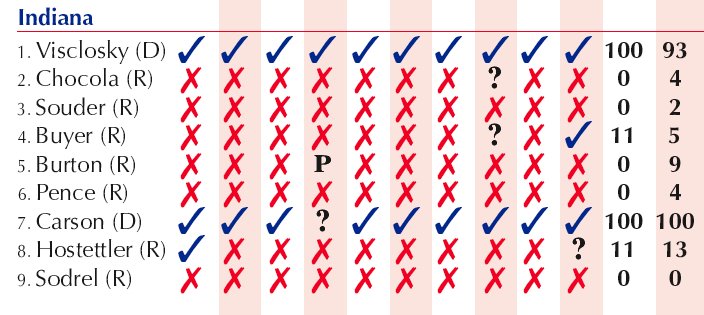
Chocola No Friend of Retirees
Alliance for Retired Americans Congressional Voting Record
109th Congress, 1st Session
January 2005—December 2005
109th Congress, 1st Session
January 2005—December 2005
This past year we saw Congress once again enact legislation that worsened the nation’s budget and fiscal crisis at the expense of retirees and older Americans. In the face of the largest deficits in the nation’s history, Congress deepened the crisis and favored only the wealthiest Americans with tax cuts. In addition, even before the Medicare Part D prescription drug program went into effect, its many flaws quickly became evident. Yet Congress did nothing.
Budget and fiscal policies dominated debate in Congress during 2005. It took Congress thirteen months to enact a budget. The result was decidedly anti-retiree. Changes in the Medicaid program now mean that states can force higher premiums, deductibles, and co-payments upon seniors in the program. Hospitals and pharmacists can refuse service if a patient cannot pay. This is a sad state of affairs for the most vulnerable in our society.
The Medicare Part D prescription drug program, coming on the heels of the disastrous discount card program, caused great confusion among seniors and their families, even before it took effect. Congress had several opportunities to make senior-friendly changes such as allow the Medicare program to negotiate for lower drug prices, extend the enrollment period without penalty, and lower rebates to drug manufacturers. But it did not act. Now seniors are faced with a bewildering program that favors drug and insurance companies at the expense of older Americans.
Social Security privatization was the one major issue for retirees and their families on which Congress did not vote. Halting privatization before a vote was due largely to the grassroots efforts of Alliance members throughout the country. We let Congress and the White House know that Social Security privatization was unacceptable. President Bush made Social Security privatization the hallmark of his second term, highlighting it during his January 2005 State of the Union Address. He crisscrossed the nation promoting it. Dozens of key members of Congress lined up to support it. In the end, the good sense of the American people of all ages prevailed. Social Security, which lifts nearly half of older Americans out of poverty, is the most successful program in our nation’s history. At a time when the baby boomer generation nears retirement, the creation of private accounts under Social Security would not only threaten the economic security of millions of retired and disabled Americans and their families, it would also add trillions of dollars in additional national debt. Stopping Social Security privatization was one great victory in an otherwise disappointing year.
This Voting Record reflects how committed our elected representatives are to retirees and older Americans. Use it to educate yourself on where your elected representatives stand. Get active today and help create an America that protects the health and economic security of seniors, strengthens families and builds safe and thriving communities.
George J. Kourpias, President - Ruben Burks, Secretary-Treasurer - Edward F. Coyle, Executive Director
The following is a list of ten key votes selected as representative of the votes
of critical importance to retirees taken by the U.S. House of Representatives:
How to read this record:
Democrat (D) Republican (R) Independent (I)
Check mark= Voted With Alliance Policy
X=Voted Against Alliance Policy
S= Speaker Did Not Vote
P= Present
?= Did Not Vote
O= Not Eligible Member
+= Announced For
_= Announced Against
AL= At-Large
The number before each name indicated Congressional District.
100%= Best Score Possible
1. Anti-Retiree Budget I
The House passed the annual budget resolution for fiscal
year 2006. The resolution sets spending and revenue guidelines.
The budget cuts domestic spending programs by $68.6
billion over five years and includes $106 billion in tax
cuts that help only the wealthiest Americans. This fiscal policy
threatens the financial stability of the Social Security
and Medicare Trust Funds. The resolution passed 218-214.
A NO vote is the pro-retiree vote. H. Con. Res. 95, Roll Call
No. 88, March 17, 2005.
2. Skewed Estate Taxes
This bill, introduced by Representative Hulshof, R-MO, would
permanently extend the repeal of the federal estate and gift
tax, which is set to expire beginning in 2010. The repeal benefits
only the wealthiest Americans, threatens the Social Security
and Medicare trust funds, and impedes funding of a
comprehensive Medicare prescription drug benefit program.
The bill passed the House 272-162. A NO vote is the proretiree
vote. H.R. 8, Roll Call No. 102, April 13, 2005.
3. Pension Protections
Rep. Miller, D-CA, introduced an amendment to the Labor
Department’s funding bill that would prohibit the Pension
Benefit Guaranty Corporation from using funds to take over
four United Airlines employee pension plans. The pensions
of more than 120,000 workers and retirees were at risk of
major reductions. The amendment passed 219-185. A YES
vote is the pro-retiree vote. H.R. 3010, Roll Call No. 309,
June 24, 2005.
4. Victims’ Court Rights
This bill, introduced by Rep. Gingrey, R-GA, would place
national caps on awards in medical malpractice cases.
The bill caps non-economic awards at $250,000. The bill
is especially unfair to older Americans, because retirees
often have only non-economic injuries since they are no
longer working. The bill passed 230-194. A NO vote is the
pro-retiree vote. H.R. 5, Roll Call No. 449, July 28, 2005.
5. Cutting Seniors Programs
The House rejected the conference report for funding the
Departments of Labor, Health and Human Services, and Education.
Included in the bill were substantial cuts to health care
spending, Medicare, Medicaid, medical research, and vital
programs such as the Older Americans Act. The House rejected
the conference report 209-224. A NO vote is the pro-retiree
vote. H.R. 3010, Roll Call No. 598, November 17, 2005.
6. Anti-Retiree Budget II
The House passed the budget reconciliation bill that made
deep cuts to programs that especially affect seniors. The bill
cuts the Medicaid program at a time when older Americans
are the fastest growing age group in the United States. Older
Americans, because of long-term care needs, use the Medicaid
program more than any other age group. The House
passed the bill 217-215. A NO vote is the pro-retiree vote.
H.R. 4241, Roll Call No. 601, November 18, 2005.
7. Skewed Tax Cuts
The House passed a tax reconciliation bill that provides
$56.1 billion in tax cuts to the wealthiest Americans. The
legislation extends tax cuts and threatens the financial stability
of the Social Security and Medicare Trust Funds. These
tax cuts occur at a time when the nation faces the largest
budget deficits in its history. The House passed the bill 234-
197. A NO vote is the pro-retiree vote. H.R. 4297, Roll Call
No. 621, December 8, 2005.
8. Corrupt Part D Passage
Rep. Pelosi, D-CA, introduced a privileged resolution that
denounced a “culture of corruption” in the House that led
to the 2003 passage of the Medicare Part D prescription
drug program. The House Leadership held the vote open for
more than three hours, which has led to investigations of
bribery. The House voted 219-188 to table (set aside) the
privileged resolution. A NO vote is the pro-retiree vote.
H. Res. 591, Roll Call No. 622, December 8, 2005.
9. Pension Reform
Rep. Miller, D-CA, introduced a motion to send a pension
bill back to the appropriate committees in order to strengthen
the bill. The new provisions would include language to make
it more difficult for companies to declare bankruptcy and
eliminate pension plans as well as specific relief for airline
industry and multi-employer pension plans. The motion
failed 200-227. A YES vote is the pro-retiree vote. H.R. 2830,
Roll Call No. 634, December 15, 2005.
10. Anti-Retiree Budget III
The House passed budget reconciliation spending cuts totaling
$39.7 billion, much of it on programs for the elderly,
poor, and disabled. States can force seniors on Medicaid to
pay higher premiums, deductible, and co-payments, regardless
of whether they are affordable. The House passed the
conference report 212-206. A NO vote is the pro-retiree
vote. S. 1932, Roll Call No. 670, December 19, 2005.
Wednesday, April 26, 2006
PRESCRIPTION DRUGS

Why should Americans have to turn to Canada to find affordable prescription drugs and better prescription prices? Why shouldn't we be able to get those same prescriptions at the same prices right here in Granger, Winamac, Walkerton, Knox, Camden, Rochester, and every other community in Indiana's Second Congressional District?
I will work in Congress to guarantee that Senior Citizens and the rest of us get a fair deal at a fair price. I will support legislation that increases our pricing power and negotiating power with the big drug companies.
Until the day comes when we do have more affordable prescription prices here in America, I will fully support your right to obtain prescription drugs from Canada at much lower prices. This will create great savings for Seniors and families, and let you keep a few more dollars in your own wallet or pocketbook.
Joe Donnelly
Thursday, April 20, 2006
Spotlight on CHINA
 China's President, Hu Jintao, is making a much-anticipated visit to the United States this week, first stopping in Seattle for a meeting with Bill Gates and then moving on to meet with President Bush. He comes at a time when the trade relationship between our countries is a disaster: a $200-billion-plus U.S. trade deficit with China is soaring while the Chinese government continues to undervalue its currency and not play by fair trading rules. The result? U.S. jobs are hemorrhaging, and the bleeding is showing no signs of stopping.
In light of the visit and the overall situation, here are some facts on the world's most populous nation:
- China increased its industrial production by nearly 28 percent in 2005 alone.
- “Outsourcing” companies promote that relocating to China’s low-wage market with little if any worker or environmental protections can immediately save 30-50% in costs.
- Five out of every six ships sent here from China loaded with products for our market return to China empty. The sixth ship likely has scrap metal or paper on board.
- Every year, 202 billion pairs of shoes are sent from China to the U.S. – seven pairs for every man, woman and child!
- Over four million Chinese are in forced labor camps producing auto parts and other products that are often exported.
- According to China’s own central bank, U.S. workers earn 33 times as much as their Chinese counterparts.
- We have a $37 billion deficit in advanced technology goods - $36 billion of which is with China (so much for the claim that Americans who lose their manufacturing job can simply move on to a high tech job).
- Right now, the number of Chinese that speak English as a second language is more than the number of people in the United States that are native English speakers.
- Though China doesn’t track rural unemployment, estimates show that overall unemployment is around twenty percent – that’s over 250 million people, or just 50 million less than the entire U.S. population.
Subscribe to:
Posts (Atom)
-
 January 1, 2009 By Michael Goodson Post-Tribune columnist For the past several months, we have listened to right-wing pundits trying to rewr...

